
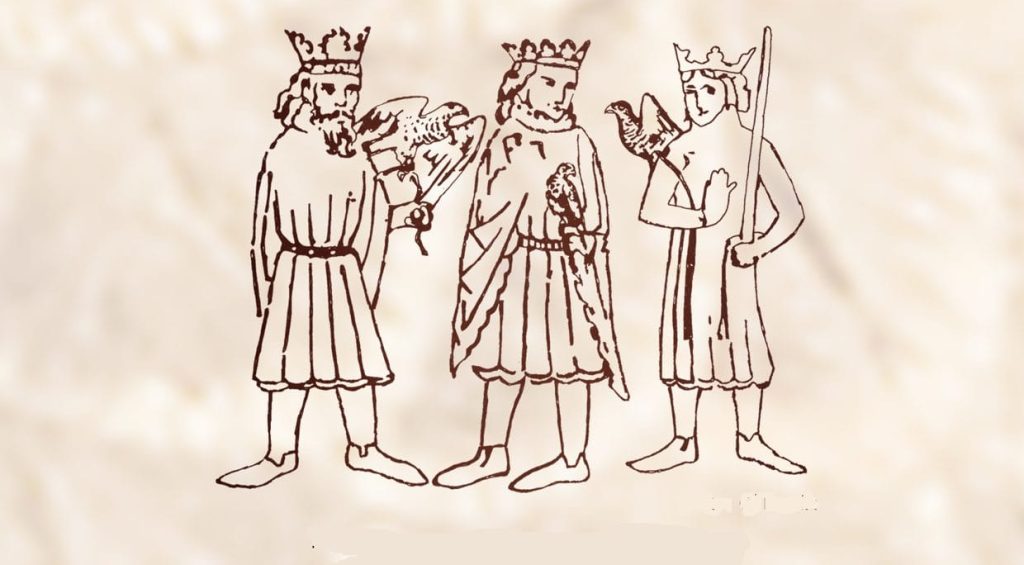
The History of Falconry in Ireland
A living heritage
Falconry, the art of hunting with a trained raptor in its natural state, has a long and fascinating history that stretches way back into the deep and distant mythical past of this ancient island – possibly even as far back as our first inhabitants. The remains of goshawks found in Mount Sandel, Coleraine (c.7000 BC), Dalkey Island, Dublin (c. 4000BC) and Newgrange in the Boyne Valley (c. 3600BC) leaves us in no doubt that a unique relationship has existed between humankind and raptors for a very long time.
Research is currently being undertaken with assistance from the National Museum of Ireland into the possibility that raptor remains at the Viking settlement at Wood Quay carry falconry DNA. This is not far-fetched given the presence of falconry in Viking culture. Dublin’s status at the time as a key Viking trade hub opens up the possibility that boats transporting gyrfalcons, a commodity harvested in Iceland, would have come through on their journey south. High King Brian Boru is also reputed to have gifted hawks and falcons to European royalty as diplomatic sweeteners.
The earliest written reference we can find of falconry in Ireland is in the Irish text Beatha Colman Maic Luachain (The Life of St Colman Maic Luachain) in the 7th Century, in which the King of Tara is described as having ‘da seabhac selga’, or two hunting hawks. Definitive and consistent falconry references, however, are nowhere to be found until the 12th Century when the arrival of the Anglo Normans finally secured falconry’s place in Ireland, albeit amongst the nobility.
At this time, the country already had a reputation for providing the best hawks available. In 1188, the Welsh monk, Giraldus Cambrensis wrote in his book Topographie Hibernae (The History and Topography of Ireland) about the abundant game and raptors: ‘Ireland has none but the best breed of falcons.’ They were so good in fact that a roaring trade opened up. Raptors, particularly Irish goshawks, became a valuable resource to pay rent or to gain political leverage with overlords. A lucrative black market soon emerged reaching a point in 1481, where stiff levies had to be imposed on trappers and tradesmen: ‘Whatever merchant shall carry a hawk out of Ireland shall pay for a hawk 13 shillings four pence, for a tiercel six shillings and eight pence, for a falcon ten shillings and the poundage upon the same price.’
But legislation existed even before this. Reginald Talbot, in 1218, was heavily fined for illegally trying to smuggle a goshawk out of the country at Dalkey. In 1386, during the reign of Richard II, a proclamation was made at Drogheda against the export of raptors, and rigorous searches took place to curb illegal trade. A 14th Century document from Kilkenny Castle details the three types of hawks used for rent payment. In 1531, Archbishop Cromer, the Louth-based Bishop of Armagh, presented a pair of hobbies to Henry VIII while in return the same king committed an annual gift of two goshawks and four wolfhounds to the Duke of Albuquerque in Spain. In November, 1562, Irish chieftain Shane O Neill sent Queen Elizabeth two horses, two goshawks and two wolfhounds. The Earl of Thomond at Bunratty Castle, Clare, has his signature on legal documents from 1615 in which the rights to his harvest of goshawks are made legally binding. Raptor stocks were actually being written into the law, such was their value.
In the late 16th Century, an inventory had been written up of goshawk nests in Kerry and Limerick. Thomas Molyneux, depicting the natural history of Leitrim in the 17th Century, says: ‘The woods are full of large and excellent timber: and well stocked with excellent goshawks.’ In his book Falconry or Hawking (edited and transcribed by Derry Argue), George Tubervile refers to one French falconer by the name of William Tardisse who stated: ‘But truly there is no goshawk more excellent than that which is bred in Ireland in the north parts, as in Ulster, and in the County of Tyrone.’
A Tudor poem describing the falconry birds available in Ireland sums up the sentiment at the time:
The Goshawke first of the crewe
deserves to have the name
The Faucon next for high attemptes,
in glorie and in fame,
The Tarsell then ensueth on,
good reason tis that he:
for flying haukes in Ireland next,
the faucon plaste should bee.
The Trasell is gentels course in nexte,
the fourth peer of the lande:
Combined to the Faucon, with
a lovers friendly bande.
The pretie Marlion is the fifth,
to her the Sparhauke nexte,
and then the Jacke and the Musket laste,
by who the birds are nexte.
These are the haukes which chefly breed,
in fertile Irish grounde:
whose match for flight and speedie wing
elsewhere be hardly founde…
From by J Derrick’s 1581 book The Image of Ireland.
The popularity of falconry continued into the 17th Century where Charles II’s viceroy Lord Ormonde established the Phoenix Park as a Royal Hunting Park just at the edge of Dublin city. The park was stocked with deer and pheasants for hounds and hawks. A high wall was built around it to keep game in and poachers out. The park was finally handed over to the people of Dublin in 1747. Meanwhile, in 1693, the Dublin Intelligence newspaper, offered a handsome reward of 30 shillings for the return of a lost hawk belonging to Lord Capall.
In his will, dated 13th April 1626, Murrough O’Flaherty of Bunowen directed that his third son, Bryan, should be left the townland of Cleggan, an extensive tract in the barony of Ballynahinch, ‘excepting onlie the aiery of hawks upon Barnanoran’ reserved for his eldest son. To illustrate falconry’s popularity and acceptance into the general community of the time, parish records from Co Down (circa 1600) issued notice that that all hawks were to have their bells removed while in church.
Things really took off sport-wise in the mid to late 18th Century. There are records from 1762 of Lord Bandon having a mews of hawks and a falconer at Ardfert Abbey in Kerry. Around 1800, the Curragh in Kildare began to be exploited as a key destination for rook and magpie hawkers. Captain Henry Salvin was based at the Curragh military camp in 1857. He and John Barr, falconer to Maharajah Dhuleep Singh, became passionate magpie hawkers, advertising meets in local papers to get beaters on board and reportedly taking 184 magpies with two male falcons in four months. EB Michell, author of the still popular 1900 treatise The Art and Practice of Hawking, references woodcock hawking in Monaghan, while Salvin was joined by another famous falconry author Gerald Lascelles for exciting rook hawking on the Curragh.
It is around this time that we come to the formation of the first Irish falconry club. In 1860, 212 Great Brunswick street, Dublin played host to a meeting chaired by Lord Talbot de Malahide to establish the Irish Hawking Club. The aforementioned Dhuleep Singh donated £50 towards the fund. After that, few records survive of what went on. Eventually, the present club was reconstituted in 1967. Prior to that, the hawking parties came and went regardless with some of the most famous authors and pioneers in falconry practice seeking out the famous hawking that existed in Ireland at the time.
One hopes they were aware of the use by Nobel Laureate WB Yeats of falconry imagery in his post-war poems at the start of the century. Yeats would often watch wild falcons from his spiritual home of Drumcliffe in Sligo. His family may also have socialised with the Coopers of nearby Markree Castle, Lord Cooper himself a keen austringer. The falcon and falconer remain vibrant symbols of matters close to Yeats’ heart. In The Second Coming (1920) we have lines such as:
Turning and turning in the widening gyre
The falcon cannot hear the falconer;
Things fall apart; the centre cannot hold;
Mere anarchy is loosed upon the world,
No history of Irish falconry would be complete without a mention of Ronald Stevens, unquestionably the guru of the sport in modern times. Stevens came to live in Connemara in the 1950s, settling in the remote Fermoyle Lodge. In a letter in the British Falconers’ Club journal, The Falconer, Stevens describes his move to Ireland, his search for a remote place where ‘my hawks can fly without risk of being sniped at’ and his hacked Jerkin coming to sit on a nearby rock ‘above the tumbling waters’ while he was fishing. Despite his best efforts, his house became something of a Mecca for falconers from all over the world. Stevens not only inspired generations through his classic treatise Observations on Modern Falconry, The Taming of Genghis and My Life with Birds but also imparted valuable knowledge to a privileged handful of Irish falconers, particularly the Hon Johnny Morris who was instrumental in reconstituting the Irish Hawking Club in 1967.
Under the re-founded Irish Hawking Club, the practice of falconry was nurtured and thrived. Under the guidance and stewardship of such stalwarts as Rowland Eustace and others, falconry as a continuing Irish heritage was steered through the second half of the 20th Century. The flying of sparrowhawks became popular in the 1980s and 90s and is reflected in Liam O’Broin’s The Sparrowhawk: A Manual for Hawking first published in 1992. Receiving worldwide acclaim at the time, the book remains a classic and changes hands on the collector’s market for large sums.
With the recent advances in artificial insemination and excellent breeding programmes, access to hawks and falcons has never been so good in Ireland. Falconry’s ties with nobility and privilege are long dead. The challenge of training these highly strung creatures is the ultimate leveller and today’s fraternity comprises people of all backgrounds. The conservative and licenced sustainable practice of wild take ensures the continuing heritage of flying our esteemed native hawks. The noble goshawk, that became extinct due to systematic persecution when falconry fell out of fashion and the use of firearms progressed, has re-established itself as a popular hunting bird for rabbits and pheasants. The male peregrine, more commonly known as a ‘tiercel’, has become a firm favourite, providing an amazing aerial spectacle in pursuit of one of our most difficult quarries, the common snipe. The enigmatic sparrowhawk that witnessed a decline in popularity in the early noughties with the arrival of the Harris Hawk is now witnessing a resurgence, as is the flying of our smallest falcon, the endearing merlin.
What has never changed in all the centuries of falconry being practised in Ireland is its demands on time, commitment and headspace. For this reason, the falconry community here is passionate but small, with probably no more than 100 participants active at any one time. We are thus unlikely to ever again witness the kind of exuberant popularity it achieved in the 17th Century where, by order of the Irish House of Lords in 1641 regarding grievances, it was prohibited within 7 miles of Dublin.
None the less, this ancient field sport is healthy and enduring, a fact recognised at state level. It was cause for great celebration in July 2019 when the art and practice of falconry was inscribed as an Intangible Cultural Heritage of Ireland, before joining almost 30 other nations around the world on an international UNESCO inventory of the same. And long may it live. In a world of increasing disconnect from our environment, falconry is not only a rich, rewarding and sustainable way to engage with the natural world on an incredibly intimate level, it is an excellent tool for conservation. The health of wild raptors, their prey species and their habitats are fundamental to it and all falconers take an active interest in them. The Irish Hawking Club has financially and practically supported conservation projects for grey partridge, red grouse, common snipe, barn owl, kestrel and common swift. Falconry’s knowledge base in managing a raptor’s diet, fitness and stress levels also makes it an invaluable tool for rehabilitating injured wild birds of prey.
Hilary White and Don Ryan
 English
  Irish
Irish  French